Qixing Huang
Geometric Regularizations for 3D Shape Generation
Associate Professor at The University of Texas at Austin
April 15, 2026 (Wed), 1:00 p.m. KST
E3-5 Building, Room 210.
Guest Lecture at CS479: Machine Learning for 3D Data
Minhyuk Sung, KAIST, Spring 2026
Abstract
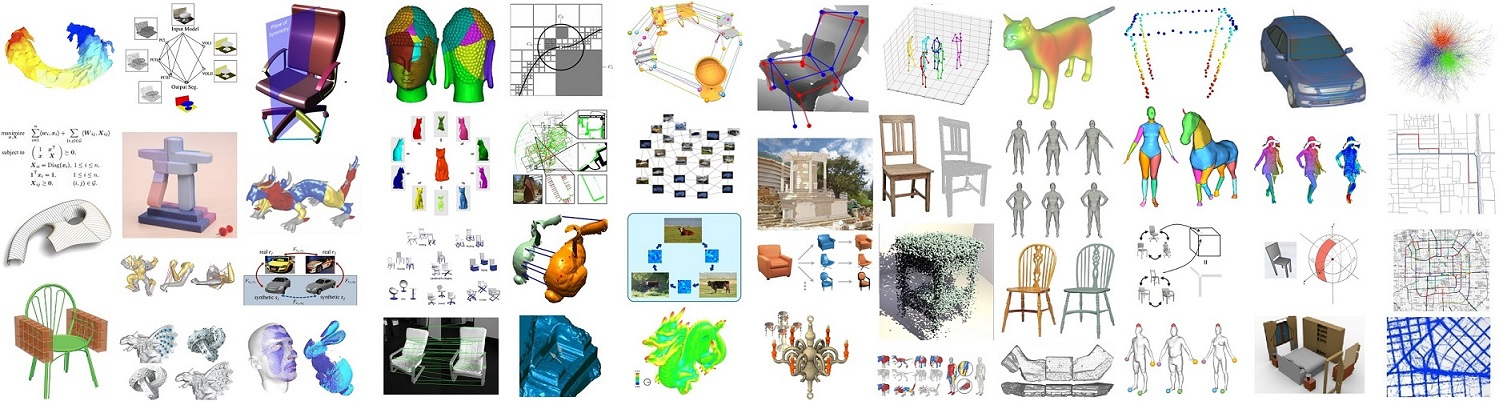
Generative models, which map a latent parameter space to instances in an ambient space, have many applications in 3D vision and related domains. A standard probabilistic formulation of these models aligns the ambient distribution induced by a generative model from a prior distribution in the latent space with the empirical ambient distribution of training instances. While this paradigm has proven highly successful for images, its current applications in 3D generation face fundamental challenges due to limited training data and generalization behavior. The key difference between image generation and shape generation is that 3D shapes possess important priors in geometry, topology, and physical properties. Existing probabilistic approaches to 3D generation often fail to preserve these desired properties, resulting in synthesized shapes with various types of distortions. In this talk, I will discuss recent work that seeks to establish a novel geometric framework for learning shape generators. The key idea is to model various geometric, physical, and topological priors of 3D shapes as suitable regularization losses by developing computational tools in differential geometry and computational topology. We will discuss applications in deformable shape generation, latent space design, joint shape matching, 3D man-made shape generation, and novel-view synthesis.
Bio
Qixing Huang is an Associate Professor in the Department of Computer Science at the University of Texas at Austin and the Director of the Visual Computing Center. His research lies at the intersection of graphics, geometry, optimization, vision, and machine learning. He has published more than 150 papers at leading venues across these areas. His research has received several awards, including multiple Best Paper Awards, the Best Dataset Award at the Symposium on Geometry Processing 2018, the IJCAI 2019 Early Career Spotlight, and the 2021 NSF CAREER Award. His recent research has been supported by awards from Adobe, Google, Amazon, and the NSF. He has also served as a (Senior) Area Chair for ICLR, NeurIPS, CVPR, ECCV, and ICCV, on the technical papers committees of SIGGRAPH and SIGGRAPH Asia, and as Co-Chair of the Symposium on Geometry Processing 2020.
-
Image from https://www.cs.utexas.edu/~huangqx/research.html. ↩